


The Centre for Gender, Diversity and Social Inclusion at the Simon Diedong Dombo University of Business and Integrated Development Studies (SDD-UBIDS) has organised a seminar as part of the global 16 Days of Activism Against Gender-Based Violence, on the theme “Ending Gender-Based Violence Against Women and Girls in Higher Education: The Role of Stakeholders.” Held on December 10, 2025, at the university campus, the event underscored the need for safe, inclusive, and gender-responsive academic environments that respect the rights and dignity of all students and staff. The event brought together students, faculty, administrators, and state institutions to reflect on the prevalence of gender-based violence (GBV), identify gaps in prevention and response systems, and strengthen institutional accountability.
In her opening remarks, Prof Constance Awinpoka Akurugu, the Acting Director of the Centre for Gender Diversity and Social Inclusion, explained that the UN has designated 25 November, which is the International Day for the Elimination of Violence against Women, as the beginning of the annual 16 Days of Activism against Gender-Based Violence (GBV) until 10 December (Human Rights Day). This underscores that GBV is an assault on women’s human rights. She added that this year’s 16 Days of Activism focuses on the theme, “End Digital Violence Against All Women and Girls”. It highlights the alarming increase of online harassment, surveillance, cyberbullying, and sexual exploitation of women and girls, and the necessity to raise awareness and establish safe digital spaces to promote gender equality and human dignity. She called upon all stakeholders to commit to combating GBV against women and girls.
 Delivering the opening remarks on behalf of the Vice-Chancellor, Prof. Bernard A. A. Akanbang, the Dean of Graduate Studies, reaffirmed the University’s commitment to ensuring a respectful and secure campus environment for all. He highlighted the existence of key institutional policies, including the Sexual Harassment Policy and the Gender Policy, currently under review and how these policies provide for protecting members of the university community from sexual harassment and dealing with gender-based violence, respectively. He emphasised that all forms of GBV are unacceptable, regardless of the gender of the survivor or perpetrator. Prof. Akanbang encouraged the university community to foster mutual respect, open communication, and tolerance in their interactions. He also reminded staff that professionalism, ethical conduct, and accountability are essential if SDD-UBIDS is to realise its aspiration of becoming an internationally acclaimed academic institution. He urged survivors of GBVto confidently use the University’s established reporting channels, assuring participants that the institution remains committed to ensuring justice and protecting those affected by GBV.
In the first session, Prof. Constance Awinpoka Akurugu, Acting Director, Centre for Gender, Diversity and Social Inclusion, delivered a detailed analysis of the nature and dynamics of GBV within Northern Ghana and higher education institutions. She underscored that GBV is a global health pandemic disproportionately affecting diverse groups of women and girls. She explained that GBV manifests in various forms, including physical, emotional, economic, and sexual violence and disproportionately affects women. She noted that GBV in general and specifically sexual violence, including coerced acts and rape, is often underreported because these are seen as prohibited topics and thus discussing them leads to stigma, shame, and further victimisation. She also emphasised the limited institutional support for seeking redress on GBV. Prof. Akurugu highlighted that GBV in Ghanaian universities frequently manifests through relationship-based violations between students and staff, verbal and physical harassment, sexual exploitation such as “sex-for-grades,” online abuse including sextortion and cyberbullying, and various forms of psychological intimidation.
Addressing interpersonal conduct on campus and sexual harassment, she cautioned members of the university community by stating, “If you do not have an informal relationship with someone, whether a staff member or a student, you have no business making comments about their looks, their outfit, or anything related to their body. Such remarks can easily make people uncomfortable and may amount to harassment.”
Prof. Akurugu presented national statistics showing that more than one-third of women experience physical and sexual violence. She added that these figures are underestimates due to barriers that prevent survivors of GBV from breaking the silence. She noted that GBV against women is widespread in higher education institutions, although it is rarely discussed. She attributed the persistence of GBV in higher education to patriarchal norms, institutional silence, fear of victimisation, and limited awareness of reporting pathways. She called for collective responsibility, survivor-centred support systems, and deliberate efforts to challenge harmful gender norms that frame GBV against women as a part of social life. She ended by urging all participants to be active bystanders; to intervene whenever there is abuse within the family, workplaces, student accommodation, on campus, and in the community. The second session was facilitated by Madam Charity Bature, the Upper West Regional Director of the Department of Gender, who examined the institutional mechanisms required for addressing GBV through coordinated, multi-sectoral action. As she began her session, Madam Bature encouraged participants to reflect on their personal roles in preventing GBV, saying, “Please pledge that from today onward, you will take deliberate steps to prevent gender-based violence, support victims, and speak out whenever you experience any form of gender-based violence.”

She highlighted the role of the Department of Gender as a coordinating entity in combating GBV against women and girls. According to her, the Regional Essential Services Package (ESP) Team provides a unified response across social welfare, legal and justice services, health services, and law enforcement. Madam Bature outlined the mandates of key institutions, including the Ministry of Gender, Children and Social Protection in coordinating national gender policy, the Domestic Violence and Victims Support Unit in investigating, supporting survivors of GBV and prosecuting GBV cases, and the Commission on Human Rights and Administrative Justice in addressing human rights violations. She identified major barriers to reporting, including survivor-blaming, fear of retaliation, mistrust of authorities, slow justice processes, and inadequate survivor-centred services. She stressed that universities must be safe environments where students can learn without fear. She concluded by calling for strengthened collaboration, transparency, and accountability among all stakeholders. She also explained that the Upper West Region is one of the few regions in the country with a shelter for abused women and girls. The Shelter, managed by her department, offers temporary support for survivors of GBV. She shared insights from her experience, highlighting the normalisation of GBV and the unwillingness of some survivors to pursue legal justice. She advised participants to take safety precautions to stay protected and to seek help if they suffer abuse.
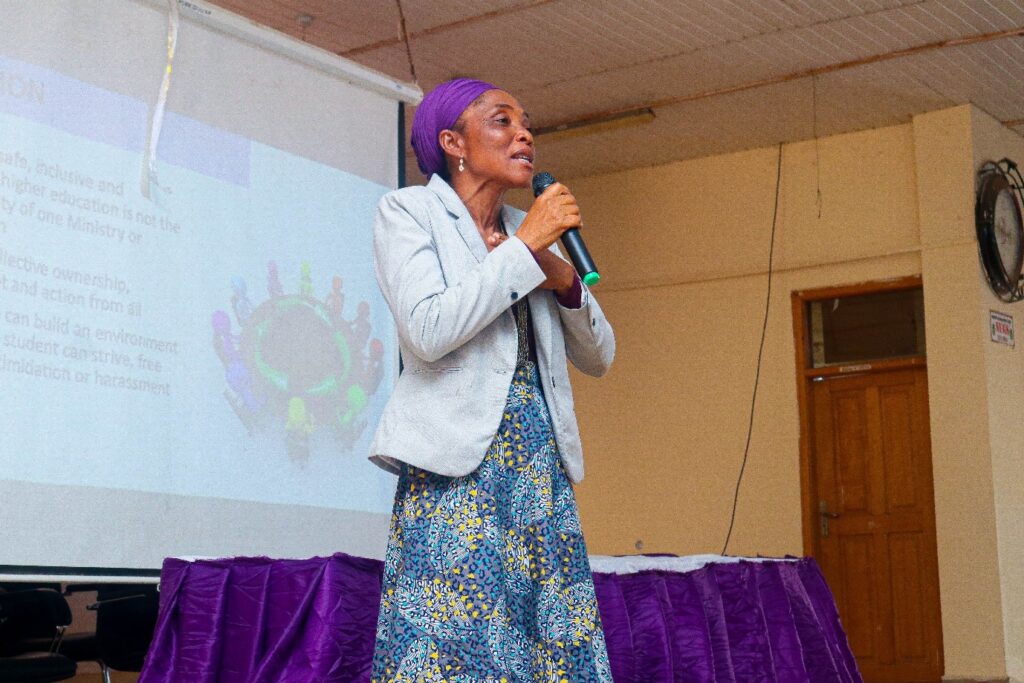 The final session was an interactive one facilitated by Dr. Grace Alenoma, Head of the Department of Sociology and Social Work at the Faculty of Social Science and Arts. Based on the previous presentations, Dr. Alenoma engaged participants in a reflective discussion on their experiences, concerns, and challenges regarding GVB and recommendations for improving the University’s response to GBV. Three stakeholder groups took turns to share their perspectives, students, administrative staff and faculty. For their part, the students highlighted the need for regular sensitisation programmes on GBV, building stronger institutional trust, that would encourage survivors to seek help without fear of victimisation. They also recommended the introduction of Gender Studies as a compulsory undergraduate course. The students also emphasised the importance of decency in dressing and suggested the development of a dress code for students. Additionally, they recommended including student representation on investigative committees for GBV cases and strengthening counselling services by providing both male and female counsellors.
The administrative staff emphasised the importance of delivering timely justice in GBV cases. They proposed that, to promote transparency and accountability, sanctions issued following investigations of GBV cases should be made public. They also entreated the Centre for Gender, Diversity and Social Inclusion to roll out more of such activities to equip staff and students with knowledge on GBV and how to address. Finally, academic staff reiterated that preventing GBV within teaching and learning environments requires both staff and students to take personal responsibility, demonstrate ethical conduct, and act proactively to foster a respectful and safe campus community.
Dr. Alenoma concluded the session by encouraging participants to reflect deeply on their individual and collective roles in fostering a culture of respect, dignity, and safety within the university community.
The seminar reaffirmed SDD-UBIDS’s commitment to building a safe, inclusive, and gender-responsive academic community.